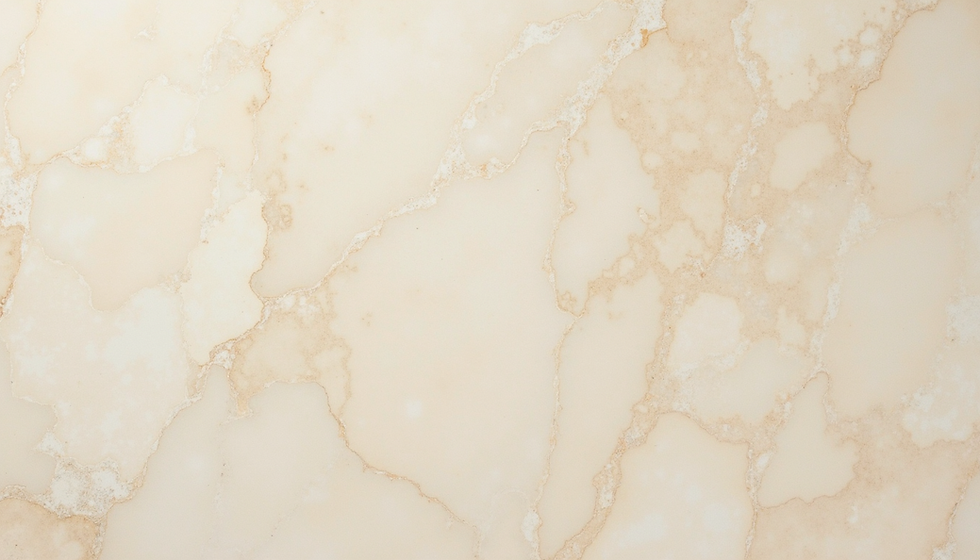
Pamukkale Travertine: What Buyers Need to Know Before They Order
- 27 Şub
- 5 dakikada okunur
There is travertine. And then there is Pamukkale travertine.
If you've specified travertine for a luxury hotel lobby, a poolside terrace, or a corporate headquarters, you already know the difference matters. Sourced from the thermal calcium-rich springs of Denizli, Turkey — the same geological phenomenon that created the iconic white terraces visited by 2 million tourists each year — Pamukkale travertine carries a mineralogical signature that no other quarry on earth can replicate.
This guide will tell you exactly what that means for your project: the grades, the finishes, the real cost factors, and the supply chain traps that cost buyers thousands. No fluff.

What Makes Pamukkale Travertine Different From Other Travertines?
Most travertine on the market comes from Iran, Mexico, or Italy. All legitimate. All usable.
But Denizli travertine — extracted from the Kaklık and surrounding formations near Pamukkale — is formed through a very specific process: mineral-rich thermal water cascading over millennia, depositing calcium carbonate in tight, consistent layers. The result is a stone with:
Unusually uniform ivory and cream tones with warm beige and walnut veining
High density (typically 2.55–2.65 g/cm³) compared to lighter Iranian grades
Low water absorption rates (often below 0.5%), critical for exterior and wet area applications
Natural void distribution that, when properly filled, produces a surface of exceptional flatness
This is not marketing language. These are measurable physical properties. Ask any supplier for their EN 1341 or ASTM C503 test results. If they don't have them, walk away.
Pamukkale Travertine: Grades, Finishes & Applications
Understanding the Grade System
The industry uses no single universal grading standard, which is where buyers get burned. Here is how reputable Denizli producers — including ourselves — typically classify material:
Grade | Description | Best Application |
Premium / First Choice | No pitting, filled voids, consistent colour, ≤2mm thickness tolerance | Hotel lobbies, luxury bathrooms, feature walls |
Commercial / Second Choice | Minor colour variation, small unfilled voids acceptable | High-traffic corridors, commercial flooring |
Rustic / Third Choice | Visible veining variation, larger voids, natural character | Landscaping, garden paths, pool coping (unfilled) |
Block / Slab | Raw quarry output for custom cutting | Bespoke architectural elements |

The Five Core Finishes — And When to Specify Each
1. Polished Mirror finish. Reflects light. Ideal for interior floors and bathroom walls. Not recommended for wet outdoor zones — slip risk.
2. Honed Matte, smooth, non-reflective. The most specified finish globally. Works indoors and outdoors. Preferred for hospitality projects.
3. Brushed (Antiqued) Textured surface achieved by wire brushing. Provides grip. Warm, aged aesthetic. Excellent for pool decks and spa areas.
4. Tumbled Rounded edges, worn surface. Rustic aesthetic. Common in Mediterranean-style architecture and garden designs.
5. Sandblasted High texture, maximum slip resistance. Used for exterior staircases, ramps, and high-traffic public spaces.
Real Cost Factors: What Drives the Price of Pamukkale Travertine?
The FOB Denizli price is just the start. Here is what actually drives your landed cost:
Slab vs. tile format — Pre-cut tiles carry 20–35% higher processing cost than slabs
Fill type — Epoxy-filled voids vs. unfilled vs. cement-filled each carry different price points and performance profiles. Epoxy is the professional standard for interior use.
Thickness tolerance — ±1mm tolerance requires more precise cutting equipment and increases price. Non-negotiable for rectified tile projects.
Crating and container loading — Marble is heavy. A 20ft container holds approximately 18–22 tonnes of travertine tiles. Sea freight from Izmir to Rotterdam runs roughly 3–5 weeks.
Customs classification — Travertine tiles fall under HS Code 6802.91. Know this before you import.
At Damlatas Marble, we provide full documentation packages including EN test certificates, packing lists with individual crate weights, and customs-ready invoices — because a single paperwork error at port can hold your shipment for weeks.
The Damlatas Advantage: Why Hybrid Sourcing Changes Everything
Here is a supply chain reality most buyers never consider.
A single-quarry supplier is completely exposed to one geological formation. If that quarry hits a problematic seam — inconsistent colour, higher void content, structural fractures — your order ships with it, or it doesn't ship at all.
Damlatas Marble operates differently. We own quarry access and manufacturing capacity in Denizli, but we also maintain a vetted partner network across 6 countries, including additional Turkish formations, Portuguese limestone operations, and Italian marble sources.
What this means practically:
If your specified Pamukkale ivory travertine lot runs short, we can match colour from a secondary source rather than ship you a mismatched second batch
We can consolidate mixed-stone orders (travertine + marble + limestone) into a single container, reducing freight costs significantly
Lead time risk is distributed — not concentrated in one quarry's production schedule
For large hospitality, commercial, or development projects where consistency across 5,000–50,000 m² matters, this is not a minor point. It is the difference between a successful installation and a costly remediation.
Common Myths About Pamukkale Travertine
Myth 1: "Travertine is too soft for high-traffic areas."
False. This applies to low-density travertines, not Denizli-grade material. Premium Pamukkale travertine has a Mohs hardness of approximately 3–4 and, when properly sealed and maintained, performs excellently in hotel lobbies, airport lounges, and commercial retail spaces. The Marriott, Hilton, and Four Seasons properties using travertine in their lobbies are not making a quality compromise.
Myth 2: "Filled travertine voids will always crack or discolour."
Partly true, often misapplied. Cement fills will crack under thermal expansion. Cheap coloured epoxy will yellow under UV exposure. High-quality clear or colour-matched epoxy fills, applied under controlled factory conditions, are stable, durable, and largely invisible. Specify epoxy. Verify it in your purchase contract.
Myth 3: "All Turkish travertine is the same."
Completely false. Travertine is quarried in dozens of locations across Turkey. Afyon, Burdur, Antalya — all different geological formations, different densities, different tonal characteristics. The Pamukkale/Denizli designation refers to a specific geographic and mineralogical origin. Insist on a certificate of origin and, ideally, a quarry visit or verified audit trail.
How to Specify Pamukkale Travertine Correctly: A Buyer's Checklist
Before you confirm any order, verify the following:
Physical test reports — EN 1341, EN 1469, or ASTM C503 for density, water absorption, flexural strength
Origin documentation — Certificate confirming Denizli province quarry source
Sample approval — Minimum 3 calibrated tiles from the production lot, not showroom stock
Fill specification — Epoxy-filled, cement-filled, or unfilled clearly stated in the contract
Thickness and tolerance — Stated in mm with acceptable deviation (±1mm for rectified, ±2mm for standard)
Shade variation classification — V1 (uniform) through V4 (heavy variation) per industry standard
Packing method — Wooden crates with foam or corrugated interlayers for slab orders
This checklist reflects the specification process we walk every client through at Damlatas Marble. Whether the order is 200m² or 20,000m², the documentation standard doesn't change.
Applications Where Pamukkale Travertine Excels
Hospitality & Hotels Pool surrounds, spa wet rooms, lobby flooring, exterior facade cladding. The thermal origin of the stone makes it, appropriately, a natural fit for wellness architecture.
Luxury Residential Bathroom walls and floors, kitchen islands, outdoor terraces, garden paths. The warm ivory palette works across contemporary and classical design languages.
Corporate Buildings Reception areas, elevator lobbies, exterior cladding. The stone's density and low maintenance requirements justify the specification over ceramic or engineered alternatives.
Summer Houses & Villas One of the highest-growth segments. Pool coping, patio paving, interior-exterior flow spaces. Brushed and tumbled finishes dominate here.